
Housing a traveling construction crew is not simply a room-rate decision. The useful planning number is the full cost of keeping the right workers rested, equipped, and close enough to the jobsite to protect the schedule.
For projects in North Carolina and South Carolina, that cost can include lodging taxes, mandatory property charges, parking, vehicle restrictions, meals, laundry, route time, reservation changes, and the cost of replacing rooms when a schedule moves. This checklist helps contractors build a realistic crew-lodging allowance before work begins.
Start with room-nights, not the advertised room rate
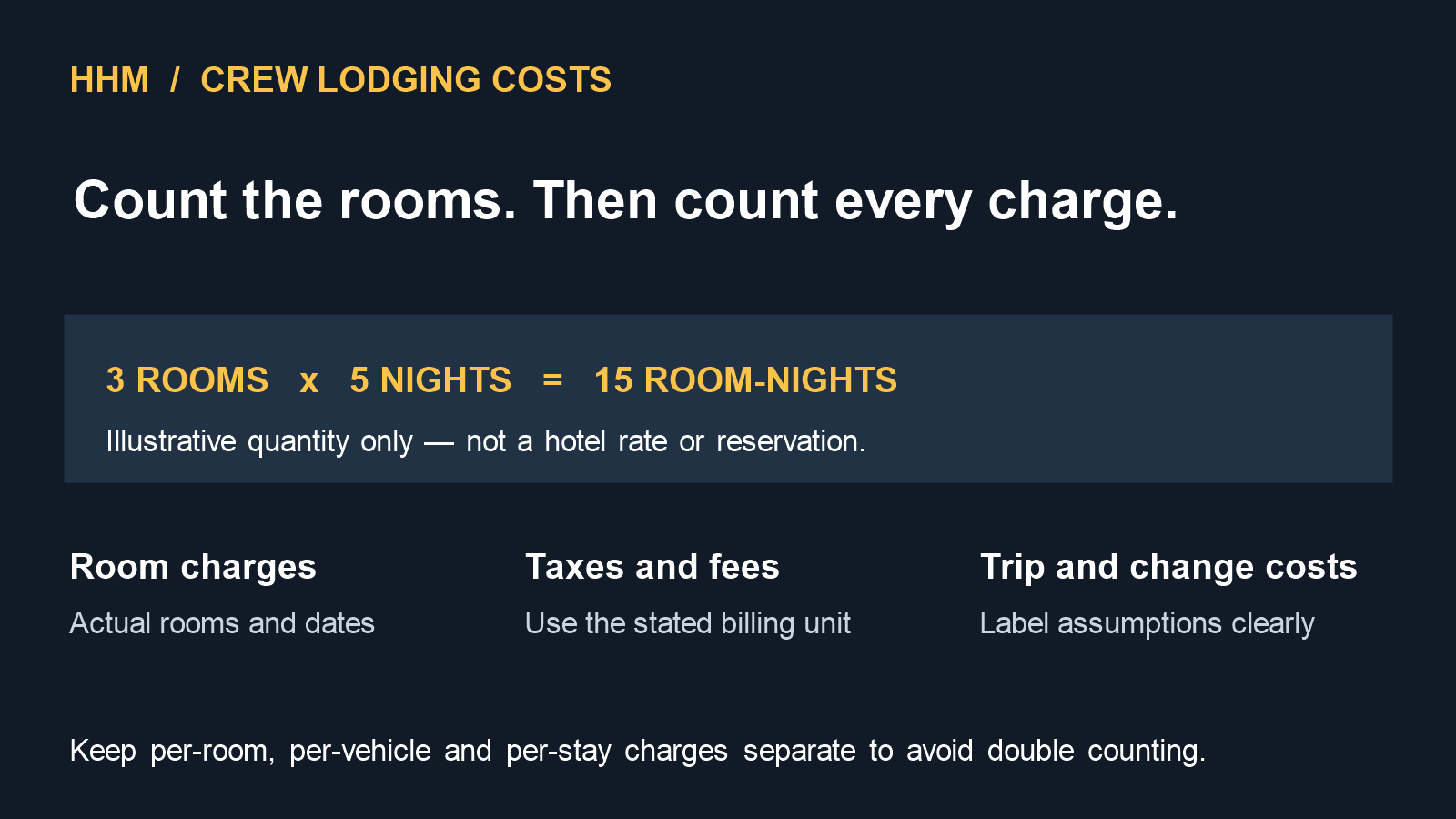
The basic unit is a room-night: one occupied room for one night. A six-person crew using three rooms for five nights creates 15 room-nights. Multiply that by the complete nightly cost, then add the costs that do not appear in the room rate.
A practical preliminary formula is:
Sum of room charges for the actual rooms and dates + applicable taxes + separately itemized fees and parking + meals + local transportation + laundry + a labeled change-risk allowance.
Use each charge’s actual billing unit: per room-night, per traveler, per vehicle, or per stay. Do not multiply a one-time fee by every night or count a charge twice when it is already included in the quoted total. If room counts or rates change during the stay, calculate each date separately.
This is a planning model, not a quote. The final amount depends on the property, dates, room configuration, jobsite address, vehicles, cancellation terms, and the taxes that apply in that jurisdiction.
Use per diem as a benchmark—not a promise of availability
The U.S. General Services Administration publishes federal lodging and meals-and-incidental-expense rates by location. Those figures can provide a consistent benchmark when a company develops a travel policy, but they are not a guarantee that a hotel will offer a room at that rate. GSA also explains that lodging taxes are excluded from the continental U.S. lodging rate.
For a private contractor, the better practice is to compare the current property total with the company’s approved travel policy and the operational needs of the project. A lower room price can lose its advantage when it adds paid parking, a long commute, restrictive cancellation terms, or inadequate space for work vehicles.
Budget Carolina lodging taxes by the actual address
Do not apply one universal “Carolina hotel tax” percentage. The correct amount can change by state, county, municipality, booking channel, length of stay, and the charges included in the reservation.
North Carolina
The North Carolina Department of Revenue states that gross receipts from accommodation rentals are subject to the general state rate plus applicable local and transit sales-and-use-tax rates and any local occupancy tax. It also explains that certain required fees can be included in taxable gross receipts. For budgeting, use the property’s complete checkout total and verify the local occupancy tax for the exact lodging-property address.
South Carolina
The South Carolina Department of Revenue explains that qualifying short-term accommodations are subject to state sales tax, accommodations tax, and applicable local taxes. It also notes that counties and municipalities may impose local accommodations taxes that are not administered by the state. South Carolina’s rules distinguish rentals to the same person for 90 continuous days, so long-duration arrangements should be reviewed using the actual contract and occupant details rather than assumed to be taxed like a short hotel stay.
Tax treatment is a booking and accounting review, not something to infer from the word “extended stay” in a property name.
Compare the operational details that affect the job
Before choosing lodging, document the crew’s actual requirements:
- Jobsite commute: compare typical drive time at shift-change hours, not only mileage.
- Vehicle access: confirm parking for pickups, vans, trailers, service bodies, or vehicles with height restrictions.
- Room configuration: specify the number of beds, private-room requirements, accessibility needs, and maximum occupancy.
- Work schedule: verify early check-in, late arrival, night-shift quiet hours, and weekend availability.
- Food and laundry: note kitchens, refrigerators, breakfast hours, nearby food options, and on-site or nearby laundry.
- Connectivity: confirm usable internet and cellular service when crews must receive drawings, photos, schedules, or field updates.
- Safety and property rules: review exterior lighting, access control, guest policies, smoking rules, and equipment-storage restrictions.
These are selection criteria, not assumptions about any individual property. Verify them directly for the dates and rooms being considered.
Price schedule risk before it becomes a change-order problem
Construction dates move. Weather, inspections, preceding trades, material arrivals, and owner decisions can shift a crew’s arrival or extend a stay. The lodging plan should therefore record:
- the cancellation deadline and penalty;
- whether unused nights can be released individually;
- the process for adding rooms or extending the departure date;
- who is authorized to approve reservation changes;
- what happens when the crew size changes;
- the backup area or property if the first option sells out.
A nonrefundable room can be economical when dates are firm. On a moving construction schedule, flexibility may have greater value than the lowest initial rate.
Keep employee reimbursement and company booking records clear
The IRS explains that business-travel substantiation generally includes the amount, date, place, and business purpose of the expense. Publication 463 also describes accountable-plan rules and the records used for lodging and other travel expenses. A contractor should have its accountant or payroll adviser confirm the company’s reimbursement policy and tax treatment.
For project controls, keep the reservation confirmation, itemized folio, occupant or crew assignment, project number, approval record, and any cancellation or change documentation together. Separating lodging, meals, parking, and other charges makes job-cost review easier.
A simple crew-lodging planning worksheet
- Record the jobsite address and expected work dates.
- List the crew count, room count, bed requirements, and vehicle types.
- Calculate room-nights for the base schedule.
- Capture the complete nightly total, including taxes, mandatory fees, and parking.
- Add meals, laundry, local transportation, and approved incidentals.
- Compare commute time and cancellation flexibility.
- Add a clearly labeled schedule-change allowance.
- Assign one person to approve changes and reconcile the final folio.
Turn the worksheet into a complete travel record
Use the HHM crew-lodging operations guide to organize travelers, rooms, vehicles, dates and approvals alongside this cost worksheet. For questions about HHM resources, contact HHM.
Verify current availability, the full itemized charges, restrictions and reservation terms directly before a booking decision. This worksheet is not a reservation or a promise of a hotel rate.
Authoritative sources
- U.S. General Services Administration: Per diem frequently asked questions
- Internal Revenue Service: Publication 463, Travel, Gift, and Car Expenses
- North Carolina Department of Revenue: Rentals of Accommodations
- South Carolina Department of Revenue: Accommodations
Sources reviewed October 1, 2026. Tax and reimbursement rules should be verified for the specific transaction and company policy.