
A flat tire does not become a work-day problem only when a tread failure happens. It becomes one when the truck’s backup plan has been left unverified: the spare is low, the retaining hardware cannot be operated, the inflation target is guessed, or the team does not know whether the spare is a full-size wheel, a temporary-use tire, or no spare at all. For a Carolina contractor fleet, spare-tire readiness is a short pre-dispatch habit—not a tire-buying exercise—and it should be specific to each truck.
Start with an inventory, not an assumption
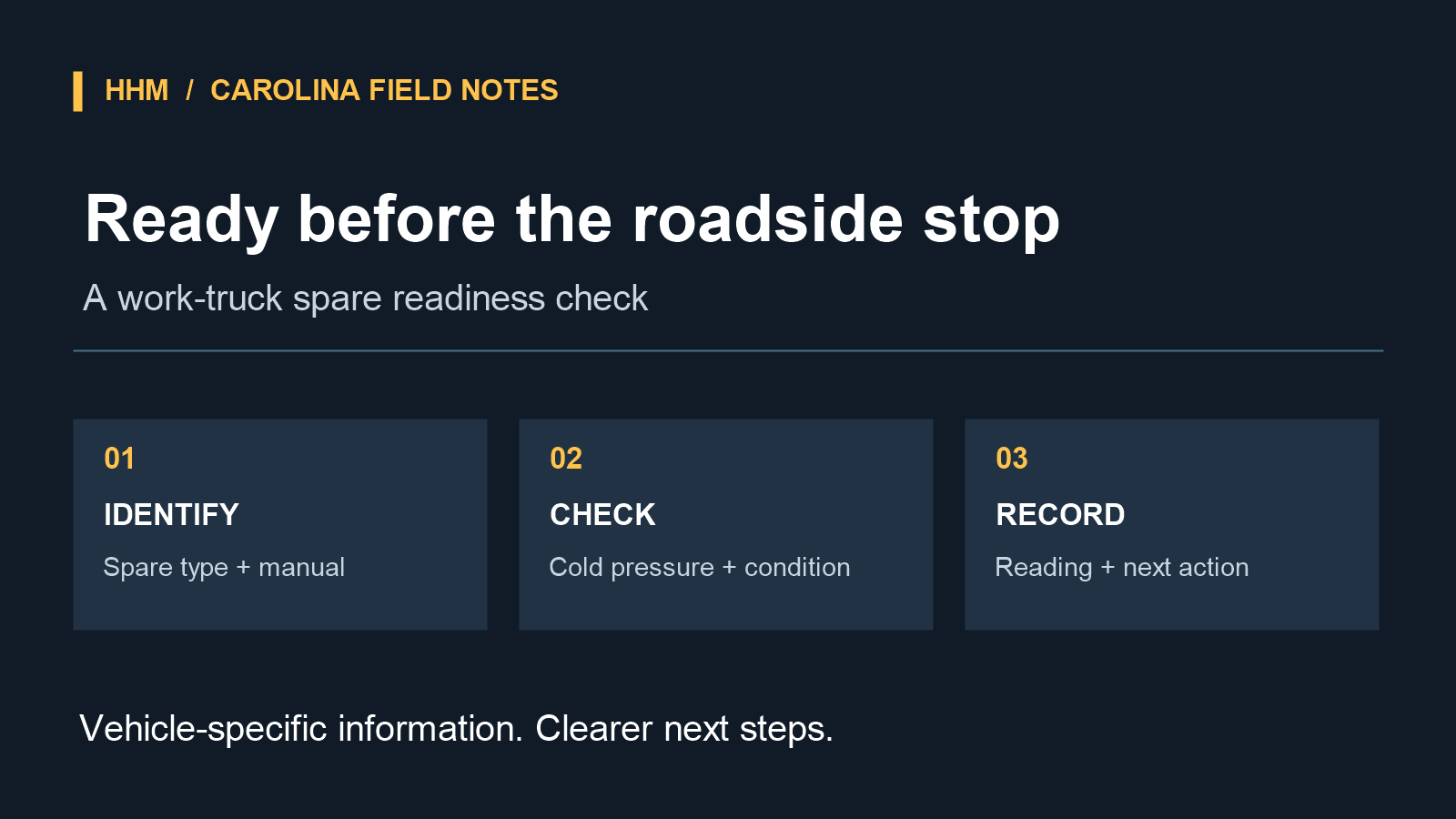
During a scheduled vehicle check, identify what the truck actually carries. Record the vehicle year, make, model, and unit number; confirm whether it has a full-size spare, a temporary-use spare, or an inflation/repair kit; and locate the jack, wrench, key, winch access, or other equipment described for that vehicle. Do not infer fitment from another truck in the fleet. A wheel, tire size, mounting point, lift procedure, and tool set can differ by trim, axle, model year, or prior modification.
That inventory has a useful second purpose: it forces a look at the stored tire rather than a glance at the vehicle’s four road tires. NHTSA’s TireWise guidance says to check the pressure of all tires, including spares, and to stop using tires showing issues such as cuts, cracks, bulges, or other physical damage. Check the spare’s accessible sidewall and tread, valve cap, wheel, carrier, and retention hardware for visible damage or corrosion. If removal is required to inspect it, follow the vehicle manual’s procedure; a stuck carrier is an equipment issue to resolve before a roadside emergency, not at the shoulder.
Use the truck’s own cold-pressure instruction
Pressure is the most important item to verify, but it is also the easiest to guess incorrectly. Use a dependable gauge with the tire cold and follow the inflation information for that specific vehicle and spare. The owner’s manual and tire-information label are the controlling reference. Ford’s owner guidance, for example, places recommended pressures on the driver-side B-pillar label and specifically calls out the spare-wheel pressure; it also notes that checking a stored spare can require removing it from its well. That is a useful reminder, not a universal pressure specification for every work truck.
Do not substitute the pressure molded on the tire sidewall for the vehicle’s specified cold pressure. Do not copy a road-tire setting onto the spare, either. A temporary spare can have a different required pressure, and a full-size spare may still have its own entry on the label. Record the verified reading, the prescribed target, date, and inspector in the fleet’s normal vehicle-check record. That gives the next driver a clear handoff without turning the check into a complicated new program.
Do not let the dashboard create false confidence
TPMS is valuable, but it is not a substitute for touching the spare-readiness process. NHTSA’s consumer guidance says TPMS warnings activate when a tire is significantly underinflated and are not a replacement for regular pressure checks. The truck’s manual explains the system’s behavior, including what happens if a spare is installed. In practice, treat the dashboard as a prompt to investigate the road tires and system—not proof that the stored spare is inflated and ready.
This matters especially for trucks that sit between jobs or rotate among crews. A stored tire can lose pressure out of view while the four road tires continue to pass a visual walkaround. Include the spare in the vehicle’s regular tire-pressure check; NHTSA recommends checking all tires, including the spare, at least monthly when cold. A vehicle-specific pre-trip check may also be appropriate when the fleet’s own procedures call for one. NHTSA also advises that a full-size spare is for emergencies rather than a substitute for replacing worn service tires.
Plan the post-flat decision before the flat
A spare gets the truck to the next safe service decision; it does not automatically return the truck to normal duty. If the vehicle has a temporary-use spare, read the tire label and the owner’s manual before it is used. Speed, distance, towing, axle-placement, chain, loading, and handling limitations are manufacturer- and configuration-specific. Ford’s manuals illustrate the point by directing drivers not to exceed the maximum speed printed on a temporary spare’s label. Do not assign a generic speed or distance rule across the fleet.
Include a simple escalation line in the driver’s instructions: after a spare is installed, notify the dispatcher, identify the spare type, check the applicable manual, and arrange inspection or repair of the damaged road wheel and tire. If the stored tire, carrier, tools, or instructions are missing or suspect, take the truck out of the assumed-ready pool until the issue is addressed. That measured preparation can keep a minor tire event from becoming a missed arrival, a risky roadside improvisation, or an avoidable scramble for the right information.
For broader construction-fleet tire planning, see HHM Custom Homes’ construction fleet tire resource.
Sources: NHTSA TireWise: Tire Safety Ratings and Awareness; Ford owner-manual tire-pressure guidance.