
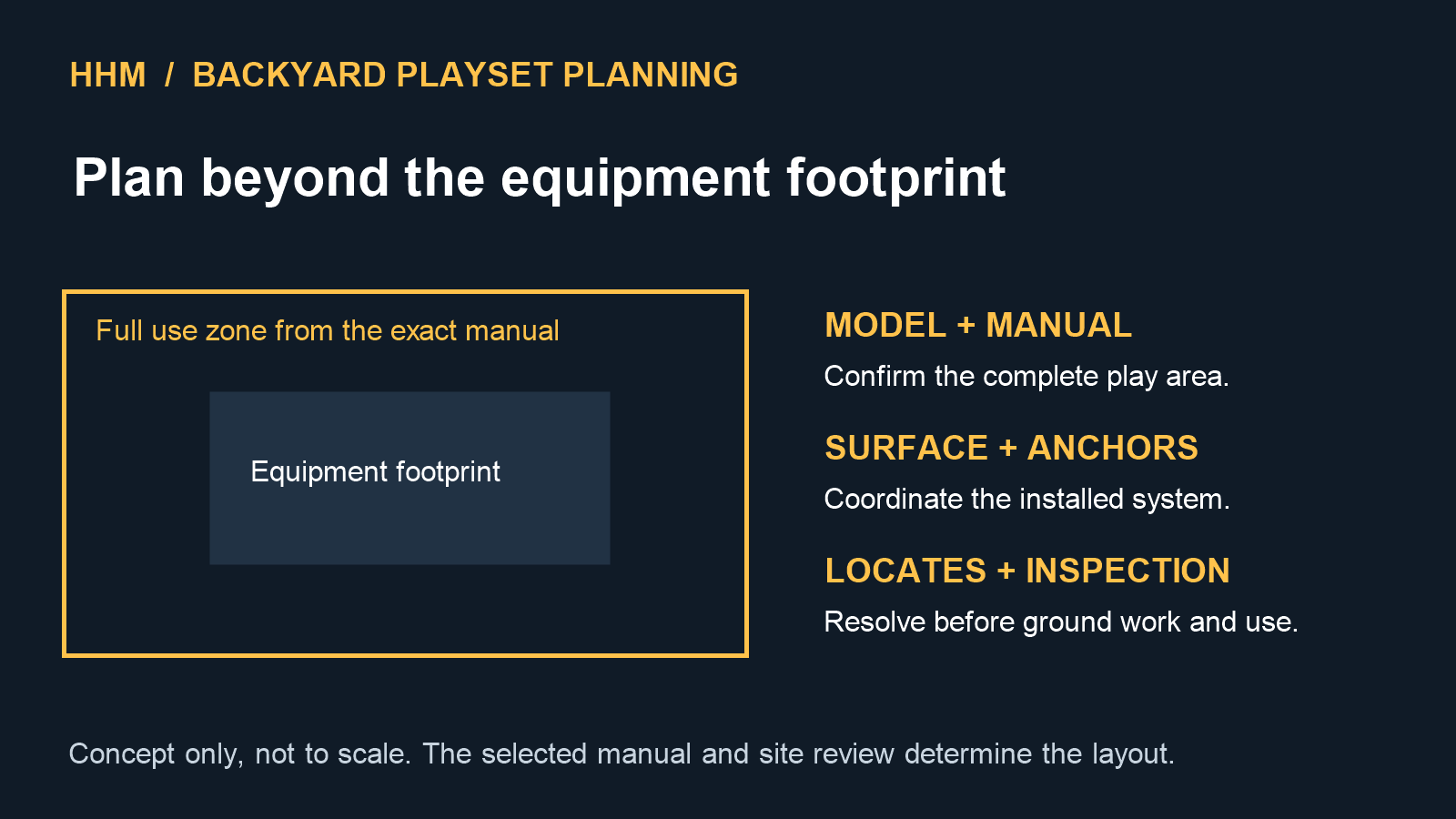
A backyard playset is not just a box of lumber or metal parts. It is an installed outdoor project whose safe use depends on the yard, the complete use zone, the protective surface, the anchoring method, and the way the equipment is assembled and maintained.
For North Carolina and South Carolina homeowners, the best time to solve those questions is before delivery. A model that fits within the property lines may still be too large once swing travel, fall zones, trees, fences, drainage, utility lines, and installation access are considered.
Plan from the product manual, not the catalog footprint
Start with the instruction manual for the exact playset model. The dimensions shown on a sales page may describe the equipment itself, while the manual can identify a larger safe-play area, overhead clearance, anchoring locations, surfacing requirements, and model-specific assembly steps.
Backyard Discovery publishes an instruction-manual library, and its manuals show why model-specific planning matters. One playset may have a tower, slide, swing beam, and monkey bars that create a very different use zone from a compact playhouse or climbing frame. Do not assume that two products with similar box dimensions need the same yard area.
Before ordering, record:
- the assembled ground dimensions;
- the full safe-play or use-zone dimensions;
- the maximum equipment and safe-play heights;
- the required anchoring method and anchor locations;
- the recommended protective surfacing and depth;
- the number and size of delivered packages; and
- any installation tools, access, or staging requirements.
Measure the complete use zone
The U.S. Consumer Product Safety Commission’s Outdoor Home Playground Safety Handbook recommends that protective surfacing extend at least six feet from play equipment in all directions. Swing areas require additional room: for a traditional back-and-forth swing, the surfacing in front and behind should extend to twice the height of the top bar from which the swing is suspended.
Those are general safety recommendations, not a substitute for the selected product’s manual. The selected product manual may require a larger or differently shaped use zone. Follow the exact model instructions and the applicable site requirements rather than treating the general six-foot recommendation as a universal footprint.
Lay out the equipment footprint and full use zone with non-penetrating markers, such as surface tape, chalk where suitable, or weighted string. Do not drive stakes, anchors or edging, dig, or adjust grade until required utility notices, responses and any private-line locating are complete. Then walk the perimeter. Check for fences, retaining walls, sheds, decks, trees, exposed roots, clotheslines, overhead branches, utility lines, drainage structures, and routes people use to move through the yard. A playset should not force children to run through a driveway or place moving swings next to a hard obstacle.
Start with solid, level ground
A visibly open patch of lawn is not necessarily installation-ready. The area should be evaluated for slope, soft fill, settlement, buried debris, exposed roots, standing water, and erosion. The playset needs to be level and square so its components align and its anchors work as intended.
Backyard Discovery’s assembly-preparation guidance calls for solid, level ground and a clear area around and above a playset. If grading is needed, define who is responsible for it and confirm that the finished elevation will still drain properly. “Level” should not mean creating a bowl that collects Carolina rainwater or directing runoff toward the house, a neighbor, or a foundation.
Do not place the equipment on concrete, asphalt, or another hard surface merely because it is flat. The CPSC home-playground guidance explains that protective surfacing is essential because falls are a major playground hazard and grass or dirt alone does not provide dependable impact protection.
Choose protective surfacing for the equipment and fall height
Protective surfacing is part of the installation, not a decorative upgrade. The appropriate material and installed depth depend on the equipment’s maximum fall height, the surfacing product, drainage, containment, accessibility goals, and ongoing maintenance.
The CPSC handbook includes guidance for loose-fill materials and unitary surfaces. Loose-fill materials can be displaced, compacted, or washed away, especially beneath swings, at slide exits, and on sloped ground. Unitary surfaces need to be selected and installed for the intended fall height rather than chosen only by appearance.
Ask the surfacing professional or product provider to document:
- the material and its suitability for the playset’s fall height;
- the prepared base and drainage plan;
- the installed and maintained depth;
- the containment edge and whether it creates a trip hazard;
- how the surface will work around anchors and footings; and
- the inspection, raking, replenishment, or repair schedule.
A thin decorative mulch layer is not automatically protective playground surfacing. The proposal should distinguish landscape appearance from impact-attenuating performance.
Follow the model-specific anchoring instructions
Anchoring reduces movement and helps the structure perform as designed, but anchor type and placement vary. Backyard Discovery’s playset anchoring guidance directs owners to the assembly manual for the location of each ground stake. The correct approach is to follow that exact manual rather than improvising a universal pattern.
Anchors, footings, and containment edges also need to be coordinated with the protective surface so they do not become exposed trip or impact hazards. If the site has loose sand, recent fill, unusual soil, a retaining condition, or a steep transition, ask the installer whether the supplied anchoring method is appropriate before assembly begins.
Locate underground utilities before disturbing the ground
Playset preparation can involve stakes, anchors, edging, drainage, grading, or excavation. North Carolina 811 specifically includes swing sets among home projects that can damage buried facilities and advises contacting the service before digging or adjusting grade. Review the NC811 homeowner safe-digging guide before work begins.
South Carolina homeowners can use the SC811 homeowner process. The person or company performing the excavation should follow the applicable notice and positive-response requirements. Standard utility locating may not identify privately owned lines such as irrigation, yard lighting, private gas lines, or wiring beyond a meter, so the property may require additional records or private locating.
Utility marks do not replace the playset manual, and the manual does not replace safe-digging requirements. Both need to inform the final position.
Check property approvals before delivery
Playset approval and permit requirements vary by jurisdiction, community, property type, equipment size, and site conditions. An HOA may regulate location, height, screening, setbacks, colors, or accessory structures even when a building permit is not required. A historic district, easement, septic area, drainage corridor, or rental agreement can add another review.
Do not rely on a neighbor’s project as proof. Confirm requirements for the property address and selected model. HHM’s guide to outdoor-structure permits, HOA review, and site access explains how those separate approvals fit together.
Plan delivery and assembly access
Large playsets may arrive in several long, heavy packages. Before delivery, confirm where the carrier can stop, who is responsible for moving packages from the drop location, whether a gate is wide enough, and where components can be stored without blocking the use zone or absorbing ground moisture.
Keep model identification and hardware organized. If the selected installation service asks for cartons to remain unopened so the installer can inventory parts and use the packaged manual, follow that written instruction. Also define who handles packaging, surplus soil, removed vegetation, and final cleanup.
For a broader view of grading, access, utilities, approvals, and outdoor-project sequencing, see HHM’s Carolina outdoor-living project planning guide.
Inspect before use and maintain the whole play area
No one should use the equipment until assembly, anchoring, surfacing, and the final inspection are complete. Verify that bolts and connectors are secure, protective caps are installed, anchors and footings are covered as intended, swing clearances are open, and no packaging, tools, sharp objects, cords, or trip hazards remain in the use zone.
Maintenance continues after installation. The CPSC recommends regular checks for loose hardware, worn connections, damaged components, exposed anchors, deteriorated or displaced surfacing, debris, and drainage problems. Recheck after severe weather and whenever the playset moves, the yard settles, or the surfacing washes out.
Do not attach ropes, clotheslines, pet leashes, cords, or accessories that the manufacturer did not approve. Continue age-appropriate adult supervision and follow the product’s use, occupancy, and maintenance instructions.
Review a current HHM installed backyard option
For customers considering a compact product-and-installation starting point, HHM currently lists the Sweetwater Playhouse – Installed Package. This product is a playhouse, not a swing-and-slide playset, so its manual, footprint, clearances, anchoring, and use guidance must be evaluated as a separate model. Use the product page to review current details. Final site preparation, protective surfacing where applicable, delivery, access, assembly, anchoring, taxes, and schedule remain subject to the written installed scope and property review.
Build one complete playset scope
A complete playset proposal should identify the exact model, use zone, site-preparation responsibility, surfacing system, anchoring method, delivery and staging plan, assembly work, approvals, utility locating, cleanup, and post-installation inspection. That is more useful than comparing assembly prices without comparing what each scope includes.
If you are planning a playset as part of a Carolina backyard project, start an HHM project intake. Include the property address, selected model or shortlist, yard photos, gate widths, slope and drainage observations, HOA information, and the desired surfacing so the entire installed project can be reviewed together.
Source review
The linked CPSC residential playground handbook, Backyard Discovery model manuals and assembly/use-zone guidance, and NC811/SC811 homeowner guidance were checked October 1, 2026. General guidance does not replace the exact product manual, utility-clearance process, property approvals or qualified site assessment.