
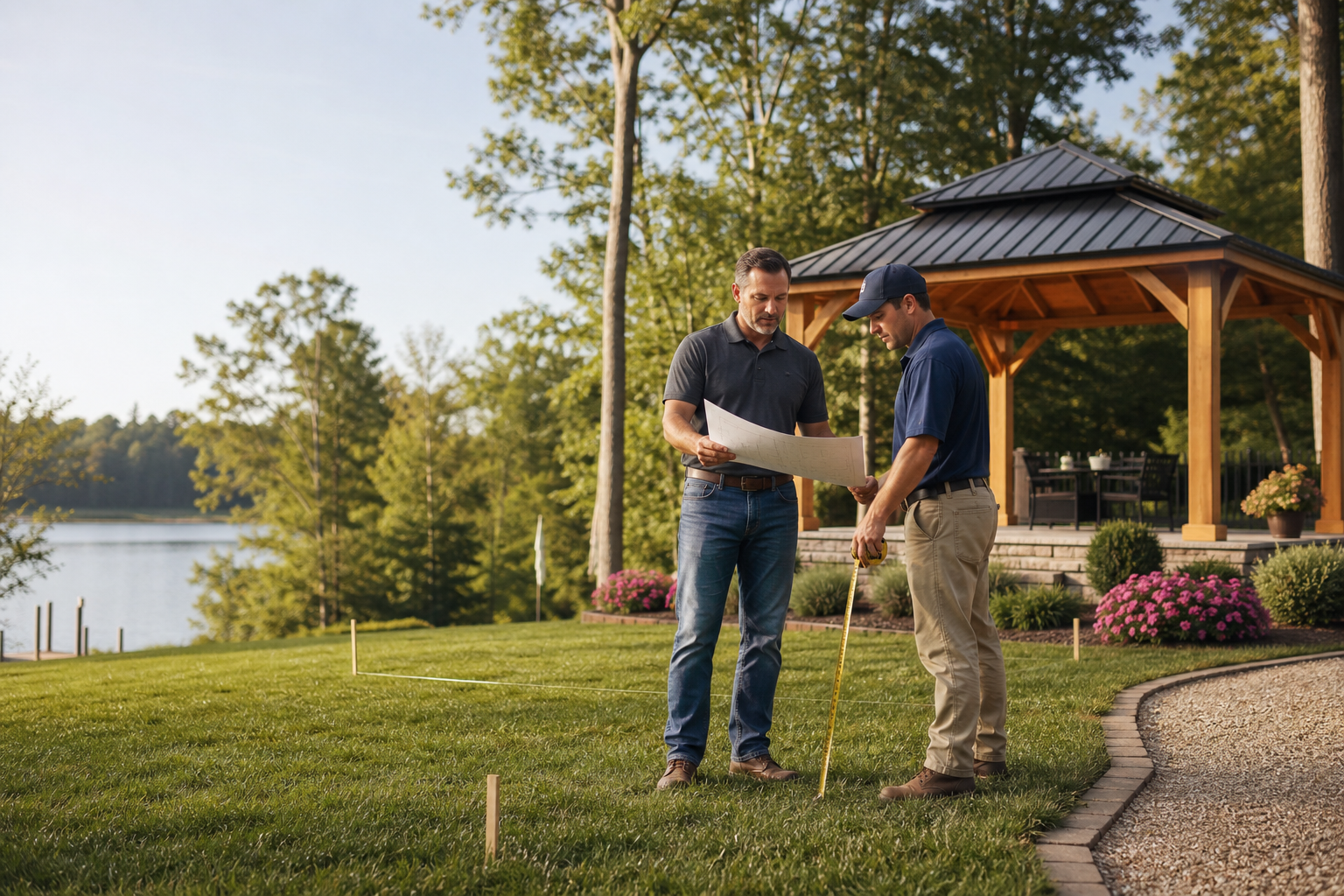
A ready-to-assemble gazebo may arrive as a defined product, but the finished result is still a site-specific installed project. The selected model has exact dimensions, boxes, hardware, assembly instructions, anchoring requirements, clearances, and maintenance information. The property adds its own zoning, permit, HOA, base, drainage, utility, access, and electrical questions.
HHM coordinates Backyard Discovery products as installed packages for North Carolina and South Carolina properties. The written proposal should connect the exact product to delivery, site readiness, assembly, anchoring responsibilities, applicable approvals, and any separately qualified trade work. A product picture or retail price alone does not define that complete scope.
Choose the exact model before finalizing the site
Begin with the current product page and assembly manual for the exact model and item number—not a similar-looking gazebo. Record the overall width, depth, height, post layout, roof overhang, assembled weight, number and size of delivery boxes, required tools, included anchoring components, supporting-surface information, and any product-specific maintenance directions.
Backyard Discovery states that product pages provide specifications and access to the applicable instruction manual. Its assembly guidance also emphasizes keeping the delivered boxes unopened until the installation team inventories parts and retrieves the manual. Confirm the handling plan in the written installed proposal; customers should not separate, modify, discard, or redistribute product components before that plan is clear.
Do not select a location from nominal product dimensions alone. Roof edges, gutters, post bases, working room, ladders, landscaping, doors, windows, equipment, fences, and future maintenance all require usable space beyond the simple advertised footprint.
Check zoning, permits, HOA rules, and property constraints
Gazebos and similar structures can be regulated as accessory structures. Requirements vary by address, size, attachment, supporting surface, electrical scope, flood conditions, historic district, and local ordinance. Charlotte’s current residential permitting guidance, for example, identifies gazebos and pergolas among detached or accessory structures that may require City review and often coordinate with Mecklenburg County building permitting. That example does not establish the rule for every Carolina property.
Before ordering or setting an installation date, identify:
- the zoning and building authority for the property address;
- setbacks, easements, utility corridors, septic or well areas, and flood or drainage constraints;
- whether a zoning, building, electrical, land-development, historic, or other approval applies;
- HOA or architectural-review documents and submission timing;
- who prepares drawings, applies for permits, schedules inspections, and closes them; and
- whether the proposed use or site condition requires design or engineering beyond the standard product documents.
An HOA approval is not a building permit, and a permit does not override private covenants. Keep both paths visible in the project schedule when both apply.
Build the installation around a solid, level supporting surface
Backyard Discovery’s assembly instructions state that the installation area must be solid and level, and its product manuals control the final support and anchoring requirements. The correct preparation may be an existing or new concrete surface, an adequately designed deck, footings, or another approved solution for the selected model and property. Do not assume loose pavers, uncompacted fill, a visibly flat lawn, or an existing deck is automatically adequate.
Document the proposed surface dimensions, elevation change, slope, material, thickness or structural framing where applicable, condition, drainage, and access for anchoring. A deck attachment requires confirmation that the structure and attachment points can carry and transfer the applicable loads; that is not established by the appearance of the deck boards.
The prepared surface should also preserve drainage. Avoid creating a pad, roof-discharge pattern, or grading change that sends water toward the house, under the structure, across a neighbor’s property, or into an area that cannot drain. Coordinate the gazebo roof runoff with the yard and any nearby patio, walkway, wall, planting bed, or stormwater feature.
Locate public and private utilities before anchoring or digging
Anchors, footings, grading, conduit, drainage, and landscape changes can disturb the ground. North Carolina 811 and SC811 both direct property owners and excavators to submit a locate request before digging and to wait for the required responses. The responsible excavator should follow the applicable state process for the exact work area.
Public 811 locating does not necessarily identify every privately owned line after a meter or service point. Irrigation, landscape lighting, pool equipment, private electrical or gas runs, low-voltage wiring, septic components, drainage, and other private facilities may require records, field investigation, or a private locator. Do not treat an empty-looking patch of yard as proof that it is clear.
Preserve locate marks and positive-response records through the work. If the proposed placement conflicts with a marked or suspected facility, stop and redesign the location or supporting work before excavation or anchoring.
Confirm delivery and assembly access
Large outdoor products can arrive in multiple long and heavy boxes. Before delivery, map the route from the delivery point to protected storage and from storage to the assembly location. Record driveway conditions, gate width, steps, slopes, soft ground, overhead branches or wires, fences, pool barriers, narrow side yards, pets, children, and surfaces that need protection.
Provide a dry, secure staging area that keeps the boxes together and accessible. The manufacturer’s assembly guidance asks customers to keep children and pets away during installation and to provide a clear path to the site. The installed proposal should state who handles placement, box movement, debris, packaging, site protection, and cleanup rather than leaving those responsibilities implied.
Separate assembly, site work, anchoring, and trade work
Assembly means putting together the selected product according to its current manual. Site preparation, concrete, structural deck work, grading, drainage, demolition, landscaping, electrical service, plumbing, gas, permits, and repairs are different scopes. Some may be required before assembly; others may be coordinated later only when the product, code, clearances, and access allow it.
If the gazebo includes a power accessory or the owner wants lighting, receptacles, fans, heaters, cooking equipment, or entertainment equipment, do not treat a factory feature as a complete field electrical system. A qualified professional must evaluate the circuit, wiring method, grounding, weather exposure, protection, switching, clearances, mounting, permits, and inspections for the actual property and equipment.
Anchoring must follow the selected manual and the approved supporting condition. The written scope should name who supplies and installs the attachment hardware, who verifies the substrate, what is excluded, and what happens if field conditions differ from the information used for planning.
Use a pre-installation readiness checkpoint
Before the crew is scheduled, confirm all of the following:
- exact Backyard Discovery model, item number, current manual, and complete delivered package;
- approved placement, orientation, clearances, property lines, easements, and overhead conditions;
- required permits, HOA decisions, drawings, and inspection plan;
- solid and level supporting surface approved for the selected structure and anchoring method;
- drainage and roof-runoff plan;
- 811 status plus private-utility review for every disturbed area;
- delivery, storage, gate, staging, equipment, crew, and weather access;
- separately qualified electrical or other trade work, when included;
- adult project contact available to confirm placement and receive closeout; and
- written product, installation, exclusion, change, cleanup, and care responsibilities.
If the site, delivered product, approval, or weather condition does not match the plan, pause and resolve it. Moving forward with an unsuitable surface or uncertain placement is not an efficient shortcut.
Review a current HHM installed gazebo option
For customers who want a defined product-and-installation starting point, HHM currently lists the Saxony Grill Gazebo – Installed Package. Use the product page to review current details and begin the installed-project path. Final site preparation, delivery, assembly, anchoring, qualified trade work, permits, taxes, and schedule remain subject to the written scope and property review.
Plan the complete installed gazebo with HHM
Bring HHM the property address, site photos, rough dimensions, preferred Backyard Discovery model, proposed location, HOA information, known utilities, delivery route, existing surface, electrical goals, and timing priorities. The written installed scope can organize the product, site review, responsibilities, and next decision around the real property.
Authoritative sources
- Backyard Discovery — What to Expect When Adding Assembly Services, reviewed October 1, 2026: unopened-box handling, solid and level installation area, clear access, children and pets, underground items, and anchoring context.
- Backyard Discovery — Gazebos and Supported Assembly, reviewed October 1, 2026: ready-to-assemble product structure, product-page specifications, box information, manuals, hardware, and assembly guidance.
- City of Charlotte — Residential Permit Guidelines, reviewed October 1, 2026: local example identifying gazebos, pergolas, and detached accessory structures within address-specific residential review and permitting paths.
- North Carolina 811 — Homeowner’s Guide to Safe Digging, reviewed October 1, 2026: locate requests, required notice, positive response, and utility-owned line context for North Carolina excavation.
- SC811 — Homeowners, reviewed October 1, 2026: South Carolina locate-request timing and safe-digging process.