
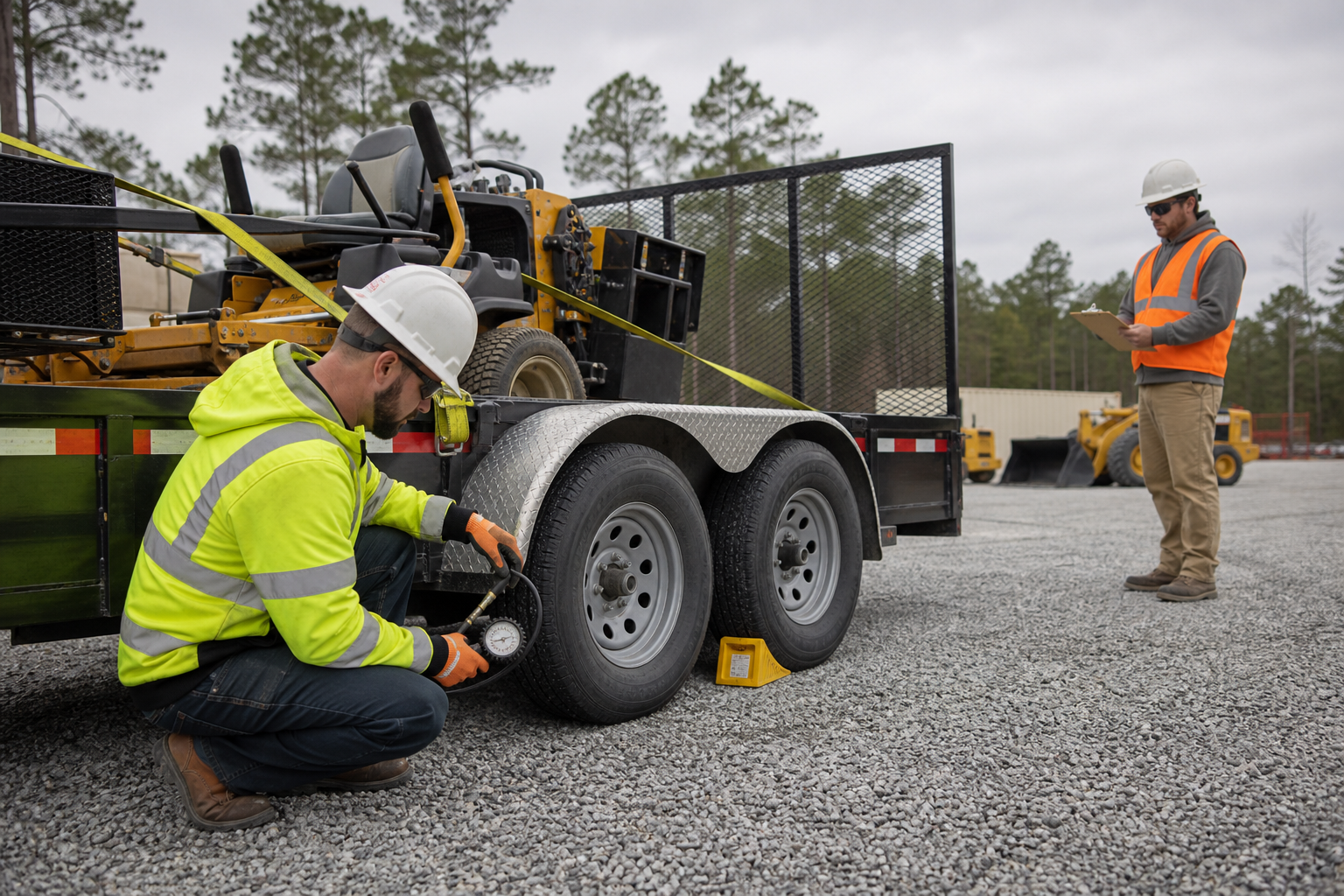
A utility trailer may carry a compact loader in the morning, lumber after lunch, and debris at the end of the day. Those assignments can place very different loads on the tires. Highway distance, summer pavement temperature, curb strikes, gravel, potholes, sidewall scrubbing, long storage periods, and uneven cargo distribution add stresses that a product photo or tire-size search cannot reveal.
The correct replacement decision begins with the exact trailer and its real working condition. Record the certification placard, gross vehicle weight rating, gross axle weight ratings, axle count, original tire specification, wheel ratings, current tire markings, measured load, normal speed and route, storage history, and visible condition. A qualified tire professional should verify the exact tire, wheel, valve, pressure, and application before purchase or installation.
Identify the trailer before comparing products
Construction businesses often own several trailers that look similar but differ in axle, brake, wheel, tire, and load specifications. Start a permanent record for each trailer. Include:
- manufacturer, model, vehicle identification number, year, and body style;
- the certification and tire-information placards, owner’s manual, and component documentation;
- GVWR and every GAWR;
- axle count, tire positions, wheel size and rating, bolt pattern, valve hardware, and spare configuration;
- the complete service description and DOT tire identification information for every tire;
- brake, suspension, hub, bearing, fender, deck, ramp, tie-down, and coupler modifications;
- normal cargo, loading method, securement points, route, speed, distance, and storage conditions; and
- inspection, repair, rotation, replacement, and mileage records.
If the placard is missing or unreadable, do not substitute a marketplace listing or another trailer’s label. Obtain the correct documentation from the trailer manufacturer or a qualified trailer professional. A wheel may also have limits that are not visible while the tire is installed, so nonstandard wheels require specific verification.
Use measured working weight, not the equipment brochure
Published equipment weight may omit attachments, buckets, fuel, batteries, fluids, spare parts, chains, binders, ramps, toolboxes, and material loaded around the machine. Trailer empty weight can also change after racks, winches, storage boxes, spare mounts, or deck repairs.
Weigh the loaded combination in a representative working condition. Obtain the total trailer weight and the weight carried by the trailer axles while the trailer is coupled as normally operated. When practical, measure individual axle and wheel-position loads because cargo that is centered front-to-back can still be uneven side-to-side. Use a qualified scale provider and loading professional when the method or result is uncertain.
Compare each measured value with every applicable rating. Do not average an overloaded wheel position or axle against unused capacity elsewhere. Tongue weight transfers load to the tow vehicle and must be considered in the tow vehicle’s payload, axle, hitch, and tire review. If the working configuration exceeds or approaches a limit without a documented operating margin, correct the cargo, distribution, trailer, or assignment before shopping for tires.
| Information | What it helps verify | What it does not prove |
|---|---|---|
| Trailer placard tire size and pressure | Manufacturer’s starting specification for the original configuration | That a modified trailer or substitute wheel remains compatible |
| GVWR and GAWR | Certified vehicle and axle limits | Actual wheel-position load or permission to exceed another component limit |
| Tire load and speed markings | Capabilities of the exact tire under specified conditions | Approval for this trailer, wheel, route, pressure, or load |
| Scale ticket | Measured load in the tested configuration | Future loading, side-to-side balance unless separately measured, or securement quality |
| A higher-rated replacement tire | Potential tire capacity when correctly applied | Higher trailer, axle, wheel, hub, brake, coupler, or tow-vehicle capacity |
Verify tire, wheel, and valve compatibility as one assembly
Tire type, size, construction, load range or load index, speed capability, service description, rim width, wheel pressure rating, and valve hardware work together. A tire that mounts on a wheel is not automatically approved for the application. The installer should verify clearance throughout suspension travel, load capacity at the intended pressure, wheel and valve pressure limits, dual or tandem-axle considerations, and manufacturer restrictions.
Do not assume that every trailer must use the same tire construction or that a light-truck tire and a special-trailer tire are interchangeable. The correct choice depends on the trailer manufacturer’s specification and the component manufacturers’ application guidance. If a proposed substitution changes tire type, size, load capacity, overall diameter, or pressure, require documented approval from the responsible manufacturer or a qualified tire professional.
All tires on an axle should meet the manufacturer’s matching requirements. Differences in diameter, construction, inflation, or wear can change load sharing and heat. On tandem or multi-axle trailers, turning can create visible sidewall deflection and scrubbing; that does not make damage, incorrect pressure, interference, or mismatched tires acceptable.
Speed and heat belong in the purchase record
Trailer-tire stress is affected by load, pressure, speed, distance, ambient temperature, road surface, and tire condition. Highway operation on a hot Carolina day is different from a short trip inside a controlled yard. Record the tire manufacturer’s speed limitation for the exact product and application, then apply the lowest governing limit among the tire, trailer, tow vehicle, road, load, and company policy.
Do not treat a speed symbol or marketing statement as permission to drive at that speed. Excessive speed can increase heat and reduce the time available to avoid road hazards. A tire with a speed restriction must not be operated above its rated limit. If an old or replacement tire’s speed capability cannot be confirmed, stop and obtain documentation rather than inferring it from appearance.
Heat after a trip is evidence to investigate, not a reason to release air from a warm tire. Compare tires using a consistent fleet procedure and qualified equipment. A tire or hub that is materially hotter than its companions may indicate pressure loss, overloading, brake drag, bearing trouble, damage, or unequal load. Remove the trailer from service until the cause is identified when abnormal heat, odor, smoke, rapid pressure loss, vibration, or visible damage appears.
Set pressure cold from approved information
NHTSA advises checking pressure with an accurate gauge while tires are cold. USTMA likewise recommends cold checks at least monthly and before long trips, heavy loads, or towing. A construction fleet’s written interval may need to be more frequent because trailers can sit unused, move between crews, encounter debris, and carry changing loads.
Use the trailer placard and the trailer, tire, and wheel manufacturers’ approved information for the exact configuration. The maximum pressure molded on a tire sidewall is not automatically the correct operating pressure for every trailer. Never exceed a wheel, valve, or other component limit. When the trailer has nonstandard tires or wheels, changed loads, or missing documentation, a qualified tire professional must establish the correct path.
Check every road tire and the spare. Confirm that the gauge covers the required range and is periodically checked against a reliable reference. Record pressure before the trip, not after the trailer has accumulated road heat. Repeated loss is a defect requiring diagnosis; repeatedly adding air is not a repair.
Inspect before dispatch and after jobsite exposure
A useful trailer inspection is deliberate and position-specific. Walk around the trailer before loading, after loading, at appropriate stops during long trips, and after rough-site exposure. Follow the manufacturers’ inspection intervals and applicable commercial requirements.
- Check cold pressure, valve caps, stems, and evidence of leakage.
- Measure tread depth in the specified grooves and look for uneven or rapid wear.
- Inspect both sidewalls for cuts, cracks, bulges, abrasions, exposed material, and impact damage.
- Look between paired or closely spaced tires and behind fenders where damage can be hidden.
- Check for penetrations, lodged debris, tread separation, flat spotting, and contact with the body or suspension.
- Inspect wheels for cracks, distortion, corrosion, elongated holes, missing hardware, or other damage.
- Verify that cargo remains distributed and secured as planned and that no new tire interference appears under load.
- Include the spare, its mount, pressure, condition, age, fitment, and accessible roadside tools.
Federal commercial-motor-vehicle rules in 49 CFR § 393.75 prohibit operation with conditions including exposed ply or belt material, tread or sidewall separation, a flat or audible leak, or a cut exposing ply or belt material. For covered tires other than the specified front positions, the rule generally requires at least 2/32 inch tread depth in a major groove, using its measurement instructions. It also addresses load, speed-restricted tires, and inflation for the carried load.
Those federal provisions apply only where the rule governs and are minimum operating conditions, not targets for a fleet maintenance plan. State law, manufacturer instructions, company policy, weather, damage, age, and the next assignment may require earlier removal. Confirm whether each trailer and operation is subject to federal or state commercial rules with a qualified compliance professional.
Age matters even when tread looks deep
Construction trailers can accumulate tire age faster than mileage. Long storage, sunlight, heat, moisture, underinflation, and extended parking under load can affect condition. NHTSA advises that aging cannot be evaluated by appearance alone and notes that vehicle and tire manufacturers may have time-based replacement recommendations.
Record the DOT tire identification information for every position and the spare, then follow the applicable manufacturer inspection and replacement guidance. Do not create a universal age limit from an online rule of thumb. When history is unknown, markings are unreadable, or the tire shows cracking, bulging, pressure loss, irregular wear, vibration, or other concerning behavior, obtain a professional inspection before use.
Use a controlled replacement and installation gate
- Identify the exact trailer and retain its placard and manufacturer documents.
- Document modifications, wheel and valve specifications, and current tire markings.
- Measure the representative loaded trailer, axle, and—when practical—wheel-position weights.
- Confirm that trailer, axle, tire, wheel, hub, brake, coupler, hitch, and tow-vehicle limits are independently satisfied.
- Verify the candidate tire’s exact size, construction, service description, load capacity, speed limitation, approved rim, clearance, and pressure basis.
- Require a qualified tire professional to approve any substitution or nonstandard configuration.
- Confirm current supplier inventory, margin-protected price, warranty, installation availability, and a correctly matching spare.
- Obtain a live, destination-specific delivery quote when delivery is selected.
- Record installation date, DOT identification, position, pressure, tread, installer, torque follow-up instructions, and next inspection.
How HHM will connect education to self-serve products
HHM’s construction-fleet catalog is being designed to connect educational guidance with live supplier inventory, verified fitment, current customer pricing, installation options, and destination-specific delivery. The article helps a buyer collect the right information; it does not approve a product.
A trailer tire should remain unavailable for checkout unless the exact supplier item is current, the application and fitment record is complete, the minimum-profit rules pass, installation or pickup is defined, and any selected delivery has a live route-specific quote. If a required field or service is unavailable, the transaction should fail closed rather than fall back to a generic product, universal delivery fee, or HHM estimate.
Authoritative sources and claim map
- National Highway Traffic Safety Administration: TireWise tire safety — cold-pressure checks, vehicle-label guidance, tread and damage inspection, tire aging, recalls, and replacement information.
- Electronic Code of Federal Regulations: 49 CFR § 393.75, Tires — current federal commercial-motor-vehicle tire condition, tread, loading, speed-restriction, and inflation provisions.
- U.S. Tire Manufacturers Association: Tire Care Essentials — cold pressure, heat and underinflation, heavy-load and towing checks, tread, alignment, and inspection guidance.
- U.S. Tire Manufacturers Association: Care and Service of Passenger and Light Truck Tires — load, wheel compatibility, trailer weighing, wheel-position load, inspection, and professional-review guidance.
Build the trailer record before comparing products
Gather the trailer placard, current tire and wheel markings, representative scale weights, normal cargo, speed and route profile, inspection history, and spare details. Use HHM’s broader construction work-truck tire guide to review the tow vehicle separately.