
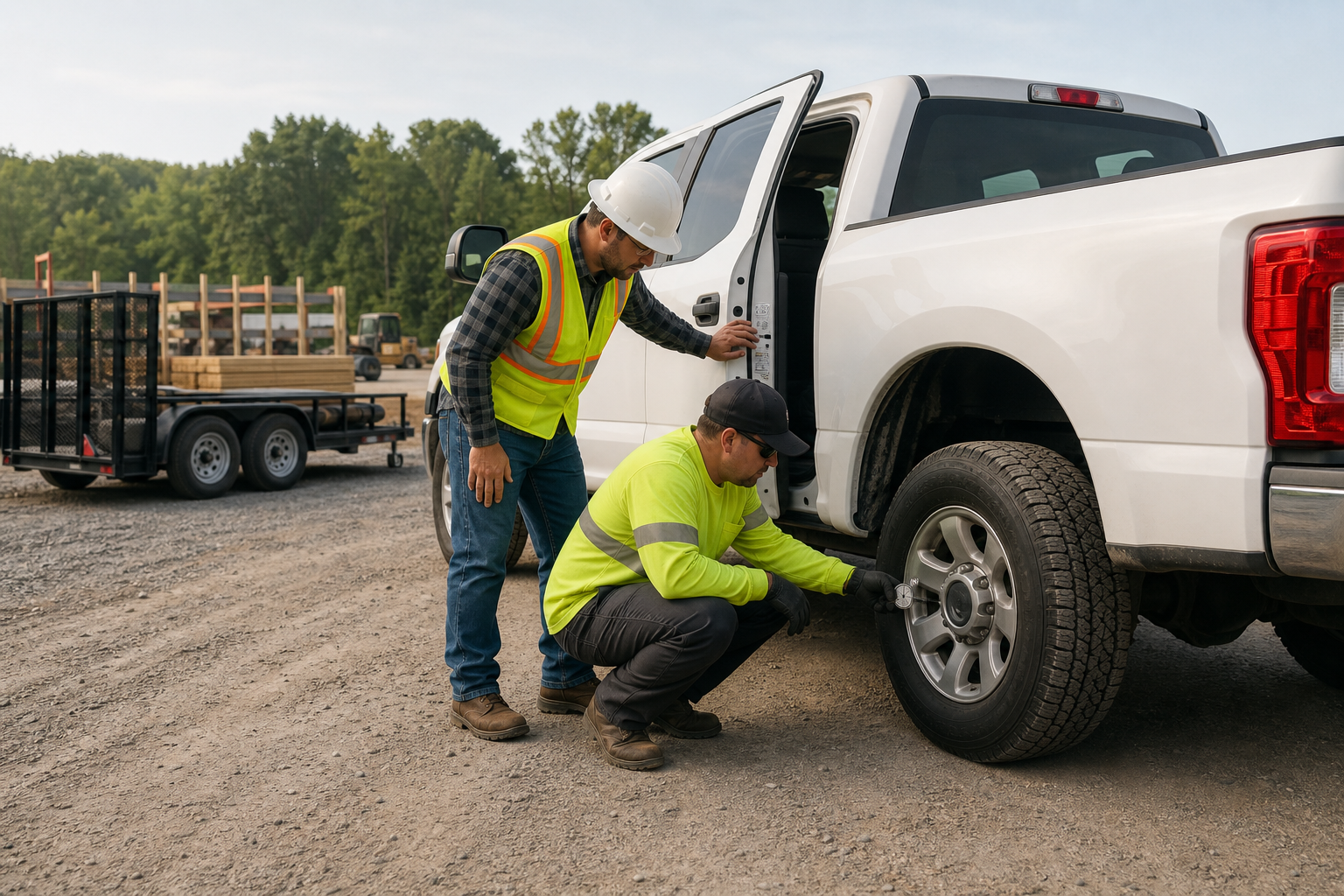
A work truck can spend the same day carrying tools on pavement, towing equipment on the interstate, crossing a wet gravel entrance, and idling beside sharp jobsite debris. That does not make one tire “best” for every construction business. It makes the selection process a fitment, loading, route, and operating-duty decision.
The safe starting point is the vehicle—not a tire advertisement. Record the exact vehicle, axle configuration, door-jamb tire and loading label, owner’s-manual requirements, current tire markings, wheel size, actual carried weight, towing duty, and road mix. A qualified tire professional should verify the final tire size, load capacity, speed rating, wheel compatibility, inflation requirements, and any manufacturer restrictions before installation.
Build a duty profile before comparing tread patterns
A useful construction-fleet profile answers five questions:
- What is the exact vehicle configuration? Record the year, make, model, trim, drive type, axle and wheel configuration, gross vehicle weight rating, gross axle weight ratings, original tire specification, and any service body, lift, suspension, wheel, or other modification.
- What does it actually carry? Include occupants, tools, racks, tanks, generators, compressors, materials, hitch equipment, and trailer tongue weight. Rated capacity is not a substitute for knowing the real operating load.
- What does it tow? Record the trailer type, loaded trailer weight, tongue or pin weight, axle count, operating speed, route, and towing frequency. The truck, hitch, trailer, tires, wheels, and load distribution all have separate limits.
- Where does it travel? Estimate the share of interstate, urban pavement, wet roads, gravel, graded dirt, mud, rock, and debris exposure. Note whether off-pavement use is occasional access or the truck’s primary duty.
- What failure would disrupt the business? A daily service van, emergency-response truck, material hauler, and occasionally used site truck may justify different durability, availability, inspection, and replacement priorities.
Understand the numbers that control the decision
The tire’s size, load index or load range, speed rating, service description, and single-or-dual load information are not interchangeable marketing labels. They are part of the fitment and capacity decision. USTMA advises that replacement tires match the size, load index, and speed rating recommended by the vehicle or tire manufacturer and not have a smaller size or load-carrying capacity than originally specified.
For a stock vehicle, begin with the tire and loading label—commonly located at the driver’s door edge or post—and the owner’s manual. For an upfitted or modified truck, also obtain the upfitter documentation and have the finished configuration reviewed. When loads vary substantially, axle-by-axle scale weights under representative working conditions can give the responsible professional better information than an estimate from a tool list.
GVWR, GAWR, payload, trailer ratings, hitch ratings, wheel ratings, and tire ratings are limits, not numbers to average together. The lowest applicable limit can control. A tire with more capacity does not increase the truck’s certified axle, vehicle, hitch, or towing rating.
Match tread and construction to the route—not the job title
| Operating pattern | Selection questions | Common tradeoff to evaluate |
|---|---|---|
| Mostly highway and paved service calls | Wet braking, highway stability, noise, rolling resistance, tread life, and replacement availability | A highly aggressive tread may add noise and wear without improving the truck’s primary work |
| Highway plus maintained gravel access | Stone retention, chip and cut resistance, wet performance, casing durability, and balanced all-terrain traction | More void and heavier construction can affect noise, ride, weight, and fuel use |
| Frequent mud or loose-soil access | Self-cleaning tread, recovery planning, sidewall exposure, load, speed, and the percentage of paved travel | Mud-focused designs can compromise highway refinement, wet behavior, wear, or efficiency |
| Heavy service body or material payload | Actual axle loads, single/dual ratings, heat, inflation, wheel rating, and duty cycle | Capacity must be verified for the whole configuration; a tougher-looking tread does not establish load suitability |
| Regular equipment or enclosed-trailer towing | Loaded axle weights, tongue weight, sustained speed, heat, stability, pressure, and replacement compatibility | The correct truck tire cannot correct an overloaded axle, poor load distribution, or an unsuitable trailer tire |
“All-terrain,” “highway,” and “mud-terrain” labels can help organize a search, but they do not prove a tire is approved for a particular vehicle, axle load, wheel, or towing operation. Compare the manufacturer’s technical specifications for the exact tire line and size—not a family-level description or a photograph.
Half-ton, heavy-duty pickup, dually, van, and medium-duty needs differ
A half-ton pickup used for estimates and light tools may prioritize wet-road control, comfort, and tread life. A three-quarter-ton or one-ton truck with a service body may place greater emphasis on verified load capacity, casing durability, heat management, and replacement availability. A dually requires careful attention to dual-load ratings, matched dimensions, spacing, inflation, axle load, and damage that may be hidden between paired tires.
Cargo and service vans can carry dense loads even when the cargo area does not look full. Shelving, parts, refrigerant, plumbing equipment, batteries, and permanently installed tools should be included. Dump and medium-duty trucks may also be commercial motor vehicles subject to federal and state operating rules. Their inspection and replacement program should be built around the actual regulatory status and use of each vehicle.
Towing changes the load and heat picture
Trailer tongue or pin weight is carried by the tow vehicle and can materially change rear-axle loading. Passengers, bed cargo, hitch equipment, and service-body weight remain part of the calculation. Before tire selection, confirm the loaded truck and trailer configuration, not just the trailer’s published empty weight.
Sustained highway speed, ambient heat, load, and underinflation can increase tire stress. The tire’s speed rating must not be treated as permission to exceed any vehicle, trailer, road, or operating limit. Check the tow vehicle and trailer tires separately; their approved sizes, constructions, pressures, and service requirements may differ.
Use the vehicle pressure specification and check tires cold
NHTSA directs owners to locate the recommended pressure on the Tire and Loading Information Label or in the owner’s manual and notes that the correct vehicle pressure is not simply the number on the tire sidewall. Pressure should be checked cold, including the spare, with an accurate gauge. A truck with nonstandard tires, unusual loading, an upfit, or commercial duty may require vehicle- and tire-manufacturer load-and-inflation information interpreted by a qualified professional.
A tire-pressure monitoring system is a warning system, not a substitute for routine inspection and pressure checks. Establish a written fleet interval, assign responsibility, and record exceptions before the truck is dispatched.
Commercial vehicles have enforceable minimum conditions
For vehicles covered by federal commercial motor vehicle rules, 49 CFR § 393.75 prohibits operation with conditions such as exposed ply or belt material, tread or sidewall separation, a flat or audible leak, or a cut exposing ply or belt material. It specifies at least 4/32 inch tread depth in a major groove on the front tires of a bus, truck, or truck tractor and at least 2/32 inch for other covered tires, subject to the rule’s measurement instructions and exceptions. It also addresses tire loading, speed restrictions, retreads or regrooved tires in certain positions, and inflation for the carried load.
Those are federal operating minimums, not a recommendation to wait until a tire reaches the threshold. State rules, manufacturer instructions, fleet policy, weather, damage, irregular wear, and the next assignment may require earlier removal. A responsible inspection program should identify and resolve those conditions before a driver is expected to make the decision at the roadside.
Use a repeatable pre-purchase and pre-trip checklist
- Capture the vehicle identification number, year, make, model, trim, axle and wheel configuration.
- Photograph the tire and loading label and record the owner’s-manual tire specification.
- Record every current tire’s full sidewall description and DOT tire identification information without publishing private vehicle data.
- Document modifications, service bodies, racks, tanks, plows, lifts, wheel changes, and permanently carried equipment.
- Obtain representative front- and rear-axle weights when the working load is material or uncertain.
- Record towing configuration, loaded trailer weight, tongue or pin weight, route, speed limits, and frequency.
- Inspect cold pressure, tread depth, irregular wear, cuts, bulges, cracking, penetrations, valve condition, and paired-tire spacing where applicable.
- Verify the exact candidate tire’s size, service description, load capacity in the intended position, speed rating, wheel compatibility, and manufacturer application guidance.
- Confirm installation, balancing, valve or sensor service, rotation plan, warranty terms, replacement availability, and disposal.
- Have the final selection approved by a qualified tire professional before purchase and installation.
How HHM’s self-serve tire path will use this information
HHM’s construction-fleet tire catalog is being connected to live supplier inventory, verified fitment controls, current customer pricing, installation options, and destination-specific delivery. A product will not be released for self-serve checkout merely because a keyword matches the vehicle or job. The release gate requires current supplier availability, an exact fitment record, minimum profit protection, current price evidence, and a live delivery path when delivery is selected.
Until those controls are active for a specific product and vehicle, use the catalog landing page to understand the process—not as a fitment approval or promise that a particular tire is available.
Authoritative sources and claim map
- National Highway Traffic Safety Administration: TireWise tire safety — vehicle-label pressure, cold-pressure checks, tread and damage inspection, tire aging, recalls, and tire-rating information.
- Electronic Code of Federal Regulations: 49 CFR § 393.75, Tires — current federal commercial motor vehicle tire condition, tread depth, loading, speed, retread or regroove, and inflation provisions.
- U.S. Tire Manufacturers Association: Tire Care & Safety — pressure, tread, rotation, alignment, inspection, aging, and professional tire-care guidance.
- U.S. Tire Manufacturers Association: Replacing Tires — replacement size, load index, speed rating, load-carrying capacity, and fewer-than-four replacement guidance.
Prepare for self-serve construction-fleet tire shopping
Gather the vehicle label, current tire markings, wheel and axle configuration, representative load, towing duty, and normal routes. HHM will display products only after the supplier, fitment, price, and delivery controls for that exact path are ready.